SandVox

Category: Articles

  • Brazilian Market Localization – All That You Need To Know For A Great Game

    class=”entry-content” id=”pix-entry-content”>

    With a population of over 213 million inhabitants in 2021, Brazil is the 6th country in the world, and one of the largest economies in Latin America. But when it comes to the revenue of the gaming industry, the Brazilian market is the leader of the continent.

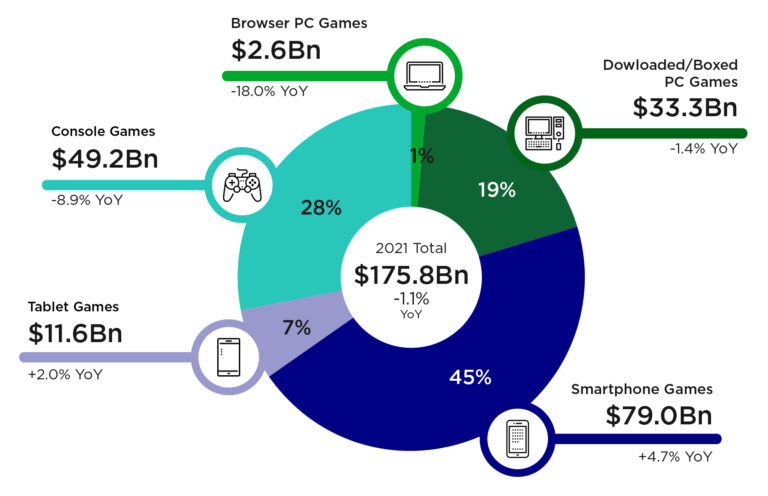
    According to Newzoo, the predicted gaming industry’s revenue in 2021 was $175,8 billion. Instead, the worldwide game market comprised 3 billion players and generated a total turnover of $180.3 billion – more than the total value of the digital music, video streaming, and movie industries together. And with $ 2.04 billion in revenue in 2021, the Brazilian market is becoming more and more interesting, attracting both national and international companies.   

    Brazilian market localization - 2021 global games market

    Being the leading Latin American country in the gaming industry, Brazil is already a regional hub development and its industry is expected to grow even further in the upcoming years. Brazilians considered games as a safe source of entertainment during the COVID-19 pandemic, so the demand for game-related products increased considerably. The country’s strong economic drive is fueling a drastic uptake in the number of gamers who are willing to pay money on their favorite platforms. In addition, recent surveys show that 72% of the online population in Brazil play video games. Therefore, the monthly spending grew in Brazil by 52%, while the revenue of Brazilian developers has doubled in the last two years.

    Brazilian audience includes 94.7 million gamers, with mobile gaming accounting for 47% of the market ($960 million in turnover and +11.8% YoY increase), console gaming 29% ($583 million), and PC gaming, 24% ($494 million).

    Brazil is a country with a very strong historical and cultural heritage, but with a very low English proficiency. According to EF EPI, it ranks on #60 worldwide and #12 in Latin America, being surpassed by countries like Poland, Portugal, South Korea, and even Argentina in terms of the English understanding EF index.

    Brazilian market localization - English proficiency

    Therefore, if you want to conquer the Brazilian gaming market, then localization into Brazilian Portuguese is the key.

    Brazilian gaming market overview

    In a nutshell, the statistical data show that:

    • 51% of the Brazilian gamers are female (32% between 10-35 years old) and 49% male (also 32% in the same age range).
    • Internet penetration is on the rise across Brazil and will be further expanded with 5G implementation. This will lead to higher-fidelity mobile games, better multiplayer experiences, and improvements in the competitive aspects of mobile esports;

    Newzoo’s 2021 Consumer Insights report highlights some interesting data about player behavior in Brazil:

    • in-game currencies are the most popular virtual goods, being bought by 43% of the players
    • in terms of the preferred game genres, mobile gamers in Brazil play mostly Sci-Fi games (42%), followed by fantasy games (41%), contemporary games (29%), and horror games (16%)
    Brazilian market - game genres
    • more than half (51%) of Brazilian gamers spend over 20 hours a week playing
    • the Brazilian gaming market is expected to grow by 5.3% in 2022 compared to 2021
    • if in the past, Brazil was a country where most gamers download free-to-play games, now, over 54.6% of video gamers paid for playing. Paying gamers spent money mostly on in-game items, virtual goods, and DLC/expansion packs
    • mobile gaming encompasses 47% of the market (representing US$1.075 billion in revenue, +11.8%YoY), while console gaming has 29% (US$657 million), and PC gaming, 24% (US$556 million)
    • on average, young Brazilian gamers spend more than 3 hours on a computer, tablet, or smartphone every day
    • 79.2% of Brazilian gamers are PC players. Except for English, Brazilian Portuguese was the 6th largest language on Steam in 2019, meaning it is a good choice when selecting languages to translate a Steam game into.
    • According to Kantar Media, Android controls more than 90% of the market share in Brazil, being the most popular operating system, followed by iOS with 7%
    • According to a Newzoo poll, Brazilian gamers especially enjoy the freedom of choice in games, character customization, science-fiction settings, and construction; on mobile, the preference remains on competitive games, including strategy, racing, and shooter titles.

    What do Brazilian gamers want?

    Like gamers from many other countries, for Brazilian players is important to have games in their own native language, especially because, as we mentioned before, Brazilians don’t have a high English proficiency.

    And, according to a Pesquisa study, localization is the 4th most important criteria for people who download and buy games in Brazil.

    Brazilian market localization - reasons to buy game

    But when speaking about localization, you need to know that you have to translate and localize your game in Brazilian Portuguese and not European Portuguese. Why?

    Well, first, because the distance between Europe and Latina America is not just from the geographic point of view, but also the historical, cultural, and modern heritage differs, leading to two different variants of Portuguese. And these differences are essential, as some words are spelled differently: Brazilians make verbs out of nouns or condense expressions and many words aren’t the same.

    Here are some examples:

    In addition, the Brazilian Portuguese vocabulary has also incorporated words from African and Native American origins over the years. Therefore, if you want to attract Brazilian gamers and provide them with the same gaming experience as the original version, you need to localize your playing into Brazilian Portuguese.

    What you should know before localizing your game for the Brazilian market

    String length

    When translating from English into Brazilian Portuguese the sentences are usually 25% longer. That’s why is important when developing your game to let enough room in the strings to allow space for longer translations.

    From the gamer’s point of view, you need to make sure that you provide enough time for reading and processing information from dialogues, subtitles, and voiceovers.

    Fonts and characters

    There are a lot of special characters both in Brazilian and European Portuguese, like á, é, í, ó, ú, â, ê, ô, ã, õ, à, and ç.

    Brazilian market - special characters

    That’s why, before starting the localization process, you need to make sure your game has international character encoding (UTF-8) and accepts these specific letters.

    Specific metrics for the Brazilian market

    When localizing your game, keep in n your mind that not just in-game text must be translated, but also different metrics. For example, Brazilian date, time, and currency formats are different. The date format is DD/MM/YYYY, compared to the English MM/DD/YYYY. In terms of time, Brazilians use a 24-hour clock. It’s “21:15h,” not “9:15p.m.”

    When it comes to currency, the commas and decimal points are the opposite of the English system. One thousand and five hundred Brazilian reals and 25 centavos, for example, should be written as R$1.500,25, compared to the same amount but in dollars: $1,500.25.

    In conclusion, to make things easier, you never have to hard-code time or currency, but store your number data internally and in files, without using a particular format.

    Be aware of grammatical genders

    Like many other languages, the Brazilian Portuguese language uses both masculine and feminine genders, affect nouns, adjectives, and pronouns. When preparing text for translation, you need to make sure that your string wrapping supports Portuguese grammar rules. Alternatively, you can ask for a gender-neutral translation. In this case, you should know that in Brazilian Portuguese the default gender is the masculine form, and you can use it when you’re trying to reach both genders.

    Names

    As English is considered a prime source for neologisms in many languages, it’s no wonder that the Brazilians are used with foreign names and may find them “cool”. Therefore, you can leave the English names untranslated. But each case is different, so you should not consider this a default rule. Instead, make the decision separately for every game and in special circumstances, consider a partial or full translation of proper nouns.

    For example, in the Portuguese version of Warspear Online, “Mask of Smiley Willy” was localized into “Máscara do Gui Sorridente”, and “Tricks of Barry the Crest” into “Travessuras de Bruno, o Crista”. Even if the names Willy or Barry could have been kept in English, they were localized, in attempting to adapt these games to the local culture.

    Holidays

    Brazil is (mostly) in the southern hemisphere, so the seasons are different compared to the northern hemisphere. As a result, instead of being full of white snow, Christmas in Brazil is hot, but a school vacation in July can get pretty chilly.

    Therefore, you should keep an eye on references to the weather or the seasons in your game, and make sure that the localized product is southern hemisphere-appropriate. It helps to ask your translator to pay special attention to any climate-related content.

    Sensitive topics

    Even if Brazilians show enough tolerance for sensitive topics, they also have taboo subjects. Sexual issues, racism, suicide incitement, and discrimination are some of the sensitive topics you should pay attention to when adapting your game for the Brazilian market.

    Sexuality is a sensitive topic because, although most Brazilian players are women, they still face a worrying amount of sexism from their gaming partners and community. If you want to avoid losing this market, you need to be careful about this.

    Violence is another topic to consider, given that Brazil has prohibited several games in the past as they included scenes of cruelty and excessive violence, including Doom and Mortal Kombat.

    Bully was also forbidden because it depicted harassment in schools, but in 2016 the ban was lifted.

    MMORPG EverQuest has been banned by the Federal Court from being sold in a Brazilian state, Minas Gerais because the players lost their “moral virtues”. The strangest ban was placed on the Counter-Strike because it contained the favela map and … “public order subversion.”

    As you can see, you can also face different interdictions from the Brazilian authorities if you don’t pay enough attention to sensitive topics.

    Culturalization

    Adapting your game to the Brazilian market means not just translating the in-game text, but also adapting the visuals according to the cultural, religious, historical, political, and economic realities.

    For example, DDTank considered localized outfits as one of their most important features when adapting their game for different markets. This way, the players can use these costumes and dress up as they want. For Brazil, they included a few costumes of Carnival, offering the players the possibility to use them, and this way the rate of the Brazilian players was higher.

    Final Words

    In conclusion, Brazil is one of the most important gaming markets in the world and the largest market in Latin America. Even so, its development has not stopped here, with the Brazilian gaming market expected to grow steadily in the coming years.

    Although they have the same preferences as European or American players, the Brazilian market will not accept games that are not localized. Therefore, if you want to win this audience, establish a presence early and give them great games by using the local knowledge!

  • Top 10 Mobile Analytics Tools to Soar Your Game Ranking

    Building a mobile game is just the beginning of your journey to success. Once you’ve accomplished this stage, it’s time to publish it, and listing your mobile game in Google Play and Apple App Store is just a part of the game. With more than 6.64 billion smartphone users in 2022 and over 3 million apps and games worldwide, competition is getting more fierce than ever. If you want to have a successful game, you must stay sharp and provide your users with a great gaming experience. But how can you know if you’re on the right track? Mobile analytics tools are the best solution.

    And this is because

    mobile analytics tools - E. Deming quote

    But what are mobile analytics tools?

    As we mentioned in our previous post, optimizing your mobile game for app stores is similar to optimizing your website and other content for the web. App store optimization (ASO) comes with a wide range of benefits, the most important being a higher ranking, increased organic traffic, and more sales.

    Because ASO and SEO (Search Engine Optimization) have basically the same goal, mobile app analytics tools aren’t too different from their web counterparts; they track and analyze users’ activity and events on games and apps.

    By seeing how people interact with your playing, you get invaluable information about how your mobile product works and how you can optimize it to be as user-focused as possible. Therefore, in an attempt to acquire new players and increase downloads and sales, you can consider mobile analytics tools as your best friend.

    But finding the right solutions can be quite a daunting task. That’s why we’ve done the hard part and gathered 10 of the most highly recommended mobile analytics instruments to help you decide which are the best options for you and your business.

    Why do you need mobile analytics tools?

    No matter how interesting and useful your game may be to potential fans, without visibility, it will not get the attention it deserves. So, you need app analytics tools to help you in gaining a good understanding of how your users engage with your app and how your game journey can be optimized to reach its goals.

    On one side you want to measure and analyze the user behavior, on the other side, you need to track the success of your marketing efforts and ad spending. That’s why you need instruments that will help you to answer questions such as:

    • which are my game’s most popular features?
    • what are my upgrade rates and why are they up and down?
    • who are my main important users and the inactive users?
    • which of my marketing efforts have the greatest impact?
    • what are the drivers of engagement and long-term retention?

    In conclusion, you need to use mobile analytics for helping you with:

    • a better understanding of your gamers’ profiles and behavior, which leads to increased ROI;
    • identify your game’s failures and successes, to create more data-driven development and marketing strategies;
    • defining, segmenting, and targeting your audiences and giving them what they want and need;
    • determining the best performing acquisition channel(s) for you so you can focus your marketing efforts in the right direction.

    Best Mobile Analytics Tools

    With so many mobile analytics instruments on the market, it can be challenging to find the right choice for you, that includes all the features you need and fits your budget. These ten tools are some of the most effective apps that can help you to improve the app store optimization for your game, boost your ranking and get more players.

    AppAnnie

    App Annie

    App Annie is a mobile and data analytics platform that combines comprehensive app market data and advanced mobile analytics to provide you with both strategic direction and tactical knowledge.

    App Annie is available for Android, iOS, and Windows Phone and gives you access to the organization’s technology innovations and data sets. This way, you can see the shared data, and identify the best opportunities for your game, while creating and developing successful marketing campaigns.

    The price is customized, but both the paid and free subscription options can help your game stand out from the crowd. The free version of App Annie provides ratings, rankings, reviews, charts, and app details, while the premium pricing plan adds ASO options, download and revenue estimates, usage estimates, advertising estimates, and audience estimates.

    App Mobile Analytics Tools by Apple

    mobile analytics tools - App Analytics Apple

    App Analytics is Apple’s mobile analytics app that gives you specific data for mobile applications and games that are published in the Apple App Store. It provides user engagement, App Store impressions, sales and trends, and user segmentation.

    By using App Analytics, Sales and Trends, and Payments and Financial Reports, you can also see how players interact within the App Store and how they discover your mobile game. Available in App Store Connect, these tools are included with Apple Developer Program membership and require no technical implementation.

    Firebase

    mobile analytics tools - firebase

    Firebase is Google’s mobile app analytics platform that supports developing, nurturing, growing, and improving your app by displaying all metrics in a single central location.

    Built for Android, C++, iOS, and Unity, this app aggregates users’ data and shares it via an immersive dashboard that allows you to have a unique view of what happening in and around your app or game. You can see the number of users and sessions, session duration, operating systems, device models, geography, first launches, the app opens, app updates, and in-app purchases.

    By using Firebase, you understand your players with rich analytics, then use our experimentation and messaging capabilities to personalize your game for different player profiles, while maximizing retention and revenue.

    App Radar

    mobile analytics tools - app radar

    With App Radar, is all about making your life easier, as it offers several tutorials to help you optimize your ASO from the ground up. This mobile analytics app comes with keyword tracking and research functionality, so you’ll know exactly which keywords to use for getting more downloads. You can also edit your app store listing, as well as reply to your app reviews directly inside the tool.

    Built for Android, iOS, and Windows Phone, App Radar provides you with key metrics tracking, localization, keyword rank tracking, keyword research tools, and more. You can also use its suite of tools to track competitors’ search strategies and optimize your ASO.

    In terms of pricing, the platform gives you the possibility to start for free and pay as you grow.

    Adjust

    Adjust

    Adjust is a mobile analytics app designed to help you identify and build your user base. The app provides a single platform for mobile attribution, campaign automation, and data privacy and protection — all informed by accurate, high-quality data.

    Built for Android, iOS, HTML5, BlackBerry, and Windows Phone, this mobile analytics app tracks hourly trends, assesses LTV, and analyzes cohorts. Notable is the platform’s Fraud Prevention Suite, which protects your application or game from fraudulent activities.

    Use Adjust to view and understand patterns and metrics of user behavior. By identifying and understanding them, you can recalibrate the mobile gaming app for your users and extend their involvement with your game.

    Kochava

    mobile analytics tools - kochava

    Kochava is a platform designed for tracking engagement, LTV, and user acquisition. Through this mobile app analytics platform, you can view important data, build user groups, and analyze ROI through pinpointed data.

    Developed for Android, iOS, tvOS, Windows & Xbox One, Unity, ReactNative, Cordova, Adobe Air, Xamarin, Web SDK, Corona Labs, Adobe DPS, Adobe Analytics, Kochava allows you to access information related to retention analytics, real-time ROI, location-based marketing, channel attribution, contextual targeting, and more.

    You can use it for real-time visualization of your campaign performance and engagement, targeted audience identification and segmentation, targeting, understanding the user funnel, and prevention of mobile ad fraud.

    Kochava’s pricing plan is simple and flexible, so it can fit every budget. It starts with a free subscription that includes App Analytics™, attribution, and more. The paid plans start from $100/month and include a 30-day free trial.

    UXCam

    mobile analytics tools - uxcam

    UXCam is an all-in-one mobile app testing and analytics tool designed for app developers (including gaming developers), mobile products teams, and marketers.

    With this one-stop solution for app analytics, you can view recordings of user sessions, which can help you identify the causes behind an app crash or bugs that affect the user experience. With the Embedded Event Analytics feature, you can go from quantitative app metrics to qualitative insights and zoom in on specific user or event cohorts with similar characteristics.

    Built for Android, iOS, Cordova, Xamarin, Flutter and React native platforms, this software can also help you out with the user onboarding process via the User Analysis tool. In terms of pricing, it starts from a free subscription and continues with a Premium and Enterprise subscription, both of them having customized values.

    AppsFlyer

    mobile analytics tools - appsflyer

    AppsFlyer is a marketing analytics and mobile attribution platform catered to mobile app and gaming marketers. Built for iOS, Android, Windows, Unity, Amazon, and TvOS, it provides the measurement, analytics, engagement, and fraud protection technologies you need to get the answers to all of your questions. This way, you can attract, retain, and engage high-value players, while increasing ROI and maximizing your marketing budget.

    It includes features such as user acquisition attribution, people-based attribution deep linking, smart banners, and performance metrics. Extremely valuable are the advanced game analytics and cohort reports that help you increase retention by giving a full view into player behavior, so you know exactly how, where, and when to engage them.

    In terms of pricing, the subscription plan starts with a free option and continues with the paid options, which come with a 30-day free trial and custom plans upon request.

    Flurry

    mobile analytics tools - flurry

    Flurry Analytics is a free mobile analytics software package built for iOS, Android, and Windows. This easy-to-use platform includes advanced functionalities like on-demand complex queries, funnel analysis, and custom segmentation, allowing you to track new users and active users, sessions, and more.

    Combining Audience insights with Segments gives you powerful insights to focus on different parts of your audience for a smarter product roadmap, superior user acquisition strategy, and more effective monetization strategy. You can also measure and analyze activity across your entire app portfolio (including crash and user acquisition analytics).

    Smartlook

    smartlook

    Smartlook is a mobile analytics tool that offers recordings to identify the customers, funnels to discover why visitors don’t take the next step, and a customizable dashboard to easily analyze the data. You can choose what events, funnels, and statistics you want to see and play related recordings right from your dashboard.

    One of the most interesting features is Mobile Heatmaps, which show your users’ behavior and their points of interest. You can generate them in a matter of minutes from the data you already have, and the Smartlook galleries automatically show heatmaps for every fragment in your app, displaying them all in one place.

    Smartlook is easy to implement thanks to SDKs for iOS, Android, React Native, Unity, Unreal, Flutter, Cocos, Cordova/Ionic, and Xamarin. In terms of pricing, it starts with a free plan for personal use and continues with paid plans ($31/month for Startup, $79/month for Business, and custom for Enterprise). All plans start with a 10-day trial, while the paid options include a 15-day money-back guarantee.

    Final words about mobile analytics tools

    Whether you’re just starting out on your mobile gaming marketing journey and want to increase your game’s visibility and ranking or want to go deeper and find more advanced data, you need a mobile app analytics tool to help you navigate the realities of ASO.

    While there are tons of mobile analytics apps available to choose from, these ten mobile application tools we highlighted above offer detailed information about your users and provide unique data points that can highlight patterns of behavior. Armed with these new metrics, you make your app irresistible to your targeted audience.


  • Top 10 Gaming App Store Optimization (ASO) Best Practices

    You’ve developed an excellent mobile game, that successfully went through all the testing stages, and now you are ready to launch it. But how do you stand out from the crowd and compete with hundreds of thousands of games that are available in Apps Stores? And perhaps more importantly, how do you get your app to rank higher in App Store search results, and make sure it matches the users’ search intent? The key is implementing efficient App Store Optimization (ASO) strategies for your game, no matter if you created it for Android or iOS system.

    However, what is App Store Optimization, and how can you make the most of it? Here’s what you need to know to help your game or app rank well.

    What is App Store Optimization (ASO)?

    Just like you use Search Engine Optimization (SEO) to get your website or blog ranking highly in Google’s search results, you must use App Store Optimization (or ASO) techniques to get your game to the top of the app store search results. Simply put,


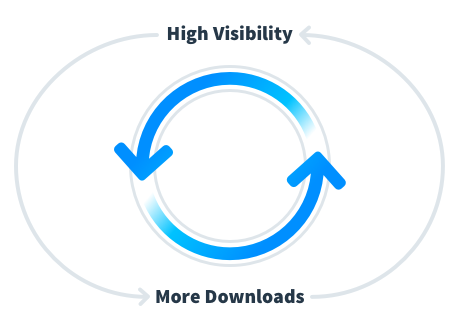
    Basically, App Store Optimization is the process of optimizing your mobile game or app to rank higher in an app store’s search results. And this includes description, keywords, and other attributes. The higher your game ranks in that marketplace’s search results, the more visible it is to potential users. This usually translates into more organic traffic to your game’s page in the app store and an increased number of valuable (unpaid) downloads.


    However, just a better position in search results is not enough to assure increased sales and revenues. You also have to make sure that once people click through to your app store listing page, they also download it or make a purchase. This part of ASO is also known as Conversion Rate Optimization (CRO).

    Why is App Store Optimization so important?

    First, because the mobile gaming market is booming, and this is not a secret. Over the last couple of years (and especially starting with 2020), the mobile gaming industry broke any records, both in the number of users and market share, and made billions in revenue.

    Let’s take a look at some data:

    • there were forecasted to be close to 3 billion gamers around the world in 2021, while 2.8 billion out of them play on mobile
    • the mobile gaming industry grew with +4.4% year on year to $90.7 billion in 2021

    App store optimization - mobile gaming market

    • by 2024, there will be 3.32 billion players worldwide (NewZoo)
    • there was a total of 80 billion mobile game downloads in 2020, with an 18% YoY growth. (AppAnnie)
    • player spending is set to reach $138 billion by 2025. (SensorTower)
    • on average, players spent 4.2 hours per day playing mobile games in 2020. (AppAnnie)
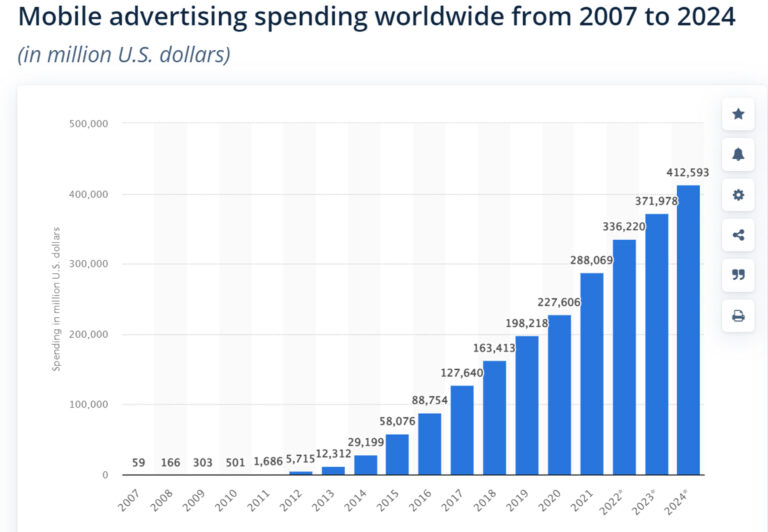
    • In 2021, mobile advertising spending reached a record 288 billion U.S. dollars worldwide (Statista), and it’s forecasted to amount to nearly 413 billion by 2024

    app store optimization - mobile ad spending

    • in 2021, mobile game spending reached $89.6 billion across the App Store and Google Play, representing 67.4 % of all in-app spending this year (SensorTower)
    • user penetration was 23.9% in 2021 and is expected to hit 28.5% by 2025. (Statista)
    • users spend 90% of their smartphone usage on apps and games. (eMarketer)
    • on average, gamers play two to five mobile games a month. (AppAnnie)
    • users spend 3 and a half hours using mobile devices every day, and 11% of that time is spent on mobile gaming. (eMarketer)

    All these data show that more and more players are using mobile devices to play games. It’s easy, it’s fun and it’s simple. And unlike consoles and PC games, they give the gamers freedom, allowing them to play wherever they are.

    When speaking about how these games are found, you have to know that according to Google, 40% of apps are discovered through app store searches. This means the search in the app store is the most used method for discovering and downloading apps and games.

    So,


    What’s the difference between SEO and ASO?

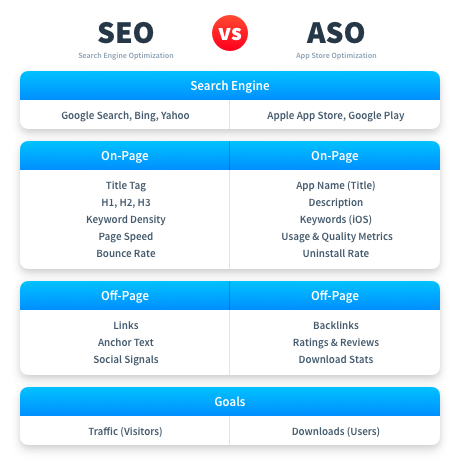
    As mentioned before, App Store Optimization is considered the SEO for app stores. Both processes include similar elements like keyword research and optimization, back linking, reviews, and conversion optimization.

    But the ranking factors are the main difference between SEO and ASO. If, according to Backlinko, there are 200 SEO ranking factors, for ASO, the list is much shorter.

    When speaking about SEO, the main important ranking factors are:

    • the keywords you optimize your pages for
    • keywords density
    • URL
    • meta-title and meta tags, meta description, Alt Tags
    • backlinks
    • page speed
    • bounce rate
    • anchor texts
    • social signal, to name just a few.

    The main important ASO ranking factors are the app name and its description, URL, keywords, rating and reviews, usage and quality metrics, the uninstall rate, backlinks, and download stats.


    App Store Optimization best practices

    Here are ten important steps you’ll want to take to improve your ASO in both the Apple App Store and Google Play.

    1. Use Keywords Wisely

    In Apple App Store, you have just 100 characters for all your keywords, so you need to use the most relevant keywords for your game and get as close as you can to this character limit. In Google Play, you don’t have any specific keyword field, but the app description is searchable, and you have 4000 characters to work with.

    For the best App Store Optimization, you should use your main keywords four to five times in your description but be careful not to exaggerate them. Otherwise, your app could be penalized for keyword stuffing, just like your website can be penalized by Google if they suspect you try to manipulate your site’s ranking in SERPs.

    Just like for your website and online content, you should make your homework and research your keywords. Chose those options that have a high search volume and low keyword difficulty, and match with your users’ search intent. App Store Optimization tools like SensorTower can help you evaluate your keywords.

    Where to insert your keywords:

    • app name
    • description
    • subtitle

    2. Write a compelling description for your game

    app store optimization - game description

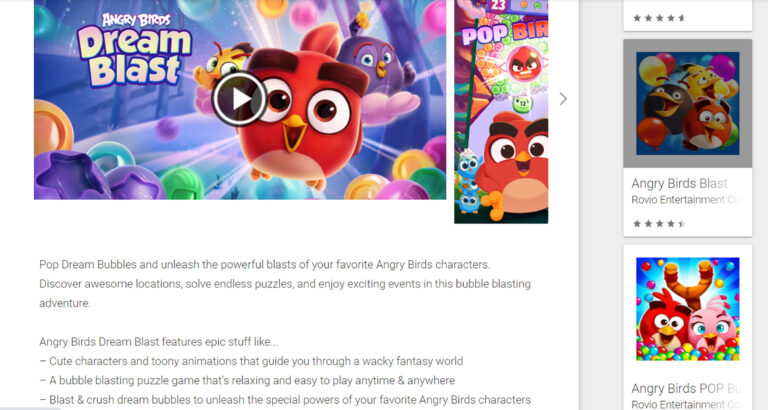
    While your game’s visual elements are the most attractive parts for many potential users, many will start by reading your description to understand your game and see if it fits their intent. And since people usually need just three seconds to make a first impression, it’s important to grab their attention in the first paragraph.

    Consider it as your sales pitch and the unique chance to convince potential users to download your game. Therefore, you should use it to tell people from the beginning what your game is all about and then continue with any narrative you want to include. Try to summarize it as best as you can and include any special features that make your game unique and stand out.

    3. Use high-quality screenshots as part of your App Store Optimization

    app store optimization - screenshots

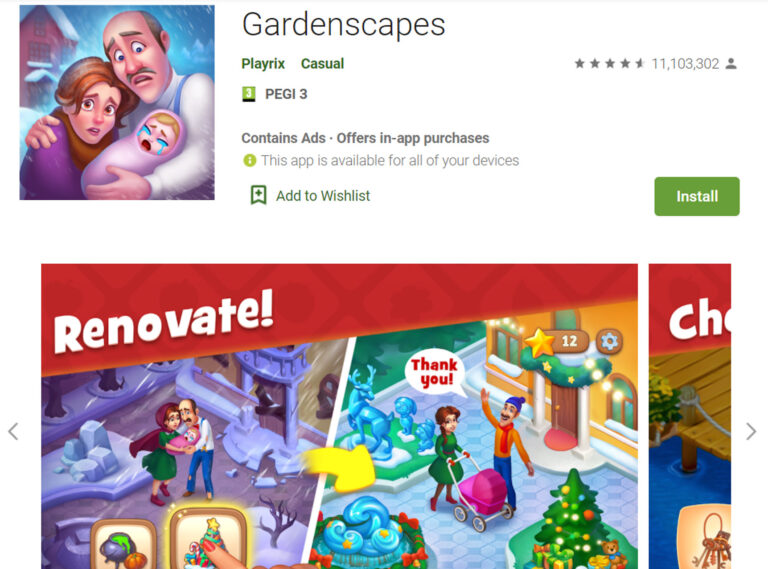
    Screenshots are a great way to convince potential players to download your game. While they don’t directly affect search rankings, imageries drive downloads if they are interesting and bold, and represent your game well. Visuals are the first thing users see when opening your game’s page, but also when they come back and search for more information. Therefore, the screenshots should give a true representation of your game, so you should really take the time to think about and select the right shots to use here.

    4. Use a video trailer

    With 82.5% of all web traffic and 86% of businesses using it as a marketing tool, online video is predicted to be the leading source of web content in 2022.

    So, if you’ve created a great video trailer for your mobile game and uploaded it to your YouTube channel or other social media pages, why not have it also on your app store listing?

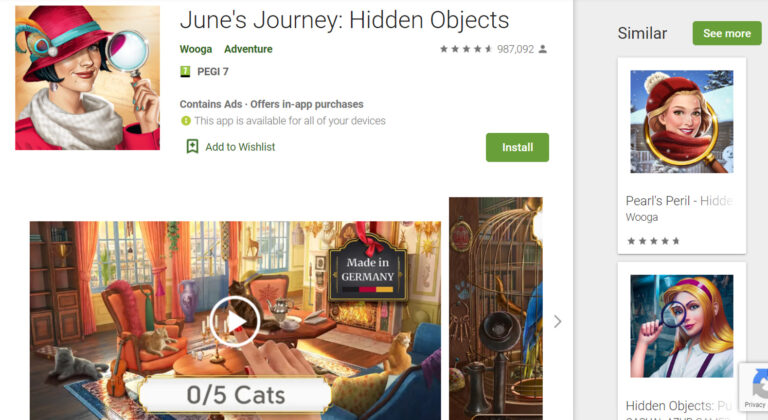
    As the name implies, a video trailer doesn’t need to be long. 30 seconds are enough to give your target audience an excellent sneak peek into what your game is about and how to play it. This way you make it easier for them to decide if it’s something they want to download and play.

    As the video content has a high impact across all the online communication channels, you can use the same trailer from your website to social media platforms to app stores and beyond. Therefore, your video should be considered a valuable investment.

    app store optimization - use the same trailer

    5. Focus on icon design

    Your game’s icon is a crucial part of your App Store Optimization strategy and plays a significant role in the number of your game downloads. So, it’s worthing to spend some time and energy to create a great one.

    app store optimization - game icon

    Of course, that’s easier said than done, so you should invest in working with an experienced designer to develop a few icon options. Try to choose the one that is most visually appealing and most representative of your game.

    6. Adapt for both Android and iOS

    Even if in 2021 Android was the leading mobile operating system worldwide with a 73% share, you still don’t want to miss out on the iOS users. But if you advertise your game saying that it can also be downloaded from Apple App Store but your iOS users can’t do this, you’ve made a very big mistake.

    As Android and iOS have different interfaces, you need to adapt your game for both platforms.

    7. Encourage feedback and update frequently

    Let’s face it, no one has just positive reviews. But handling bad reviews can be tough, especially when their number is increasing. Instead of letting it set you back, consider these negative reviews as a great opportunity to listen to what your audience is saying and understand what your potential users really want. Then work with your development team to make necessary improvements and adjustments.

    Many mobile players like to see that games are constantly improving thanks to customer feedback, while app stores also value more frequently updated games.

    8. Be prepared for localization

    Even if the majority of your target audience speaks and regularly plays games in English, it doesn’t necessarily mean they use the English version of their app store. In fact, 72% of consumers outside the English-speaking world prefer to use their own languages, but there is still a way to reach these communities.

    By localizing your game on both the Google Play Store and the iTunes App Store, you can adapt your brand communication and language for different countries to make your game discoverable. Check out our 10 best practices to localize marketing content.

    That’s why localizing your game and translating your title, keywords, and game description can work for you in a big way.

    9. Use App Store Analytics

    Like Google Analytics for web page marketing, several powerful app store analytics tools are designed to help your mobile marketing strategy. You will be able to see where your game stands compared to the competition and use the right ASO strategies to increase your ranking.

    Some analytics apps are:

    to name just a few.

    These tools are useful because they give you data related to your game. Their indicators can show you what you’re doing wrong in marketing your game, how to improve your game ranking in the app store, and much more.

    10. Re-evaluate regularly

    If it’s been a few weeks, and you’re not pleased with your app’s current app store ranking, it’s time to take a look at your data, make some assessments, and change some things around:

    Regular evaluation is an important part of your ASO and overall marketing strategies. Depending on how your data looks and the current ranking of your game in the app store, you may decide to change and improve a few things:

    • find more relevant keywords
    • change the description
    • make sure you listed your game in the right category
    • fine-tune the icon
    • change the screenshots

    When you make changes, it’s important to make them one at a time, and then wait to see their impact.

    Takeaway

    Like SEO, ASO is a process that needs to be constantly monitored and improved. The best set of keywords is not always the set you chose when you first listed your game in the app store.

    Most game developers do not research at all, or are too little interested to search the keywords their audience uses when looking for something in the app store. And this can be seen sooner or later in the number of downloads of the game.

    You need to invest time and effort to get the most out of App Store Optimization. If you do, you will have a consistent channel that drives traffic to your game.

  • Best Gaming Influencer Marketing Platforms To Use in 2022

    class=”entry-content” id=”pix-entry-content”>

    Like it or hate it, almost every industry has used influencer marketing in recent years, and the gaming industry is no different. As a result, influencer marketing platforms have become extremely important, especially in the last two years.

    Let’s face it, social media has been one of the most impactful inventions in the last three decades. Almost 48% of the world’s population is active on at least one social media platform, be that Instagram, Facebook, YouTube, LinkedIn, or Twitch, to name just a few.

    But people don’t just follow and interact with their friends, they also use social media to find meaningful content: in fact, 54% of users also follow their favorite brands and celebrities they admire. Besides, in the first quarter of 2021, fans around the world watched around 8.8 billion hours of video game live streams — a nearly 180% increase over the same timeframe the previous year. So, it’s no wonder that influencer marketing is becoming one of the most effective ways to promote video games, while the gaming influencers are becoming a sort of kingmakers.    

    And regardless of you’re a gamer looking to break into influencer marketing, or a gaming brand looking for an influencer to work with, influencer marketing platforms are a great solution to reducing the time spent in connecting – time you can rather use to optimize your campaigns. 

    What is influencer marketing?

    The influencer marketing definition states that this is a type of marketing that focuses on partnering with people who are active on social media and have a large and engaged number of followers. And this includes from bloggers to celebrities and anyone in between.

    When speaking about influencers, we can identify four categories:

    • Nano-influencers – influencers with less than 1,000 followers; typically, they have immense knowledge influence in an extremely specific niche;
    • Micro-influencers – influencers with 1.001- 40.000 followers; generally speaking, they are ordinary everyday people who have become known for their knowledge about one or some specific niches;
    • Macro-influencers – influencers with 40.001 – 1 million followers; this group tends to include two types of people: smaller celebrities and successful online experts;
    • Mega-influencers influencers with over 1 million followers. These are often (but not limited to) celebrities who have gained their fame outside of social media

    Quick overview of the influencer marketing landscape

    • according to Influencer Marketing Hub, the influencer marketing estimated market size was $9.7 billion in 2020, and it was expected to reach $13.8 billion in 2021
    gaming influencer marketing platforms - market value
    • HypeAuditor stated that nano-influencers with less than 5,000 followers have the highest engagement rates (5%); this decreases as the number of followers grows, leading to an engagement rate of 1.6% (of celebrities);
    influencer marketing platform - influencer engagement
    • according to the same study, 47.3% of influencers are micro-influencers with 5,000 – 20,000 followers on their biggest social media platform. They are followed by mid-tier influencers (26.8%) and nano influencers (18.74%);
    • as micro-influencers have higher engagement, it’s no wonder that marketers and brands are more interested in working with them than with traditional celebrities;
    •  Statista states that almost 84% of all social media influencers are women compared to just 16% of men
    • 97% of marketers consider Instagram the most important influencer marketing channel, followed by Facebook (79%), YouTube (45%), and Twitter (35%)
    • Twitter estimates that 49% of the users made a purchase based on an influencer recommendation

    Influencer marketing benefits

    Influencers are influencers for a reason, and they hold a lot of sway over their followers. Here are the top three benefits of working with gaming influencers:

    Increase Reach and Traffic 

    Here’s the thing about video game influencers – they have the power for engaging audiences during video game streams. If they appear in your videos and/or create content about your game, you gain traction.

    So, rely on the ability of the influencers to connect with the audience and you will see good results coming their way.

    Capitalize on the “Influence” 

    Regardless of the industry, influencers are opinion leaders who exercise a sense of influence over their audience. Therefore, what they say about a brand or a game can have a huge impact and even change the way their audiences view or buy a product. 

    Working with gaming influencers will not just bring your brand in front of their audiences but could also help you to expand your fan base and turn them into customers. 

    Drive Audience Engagement through Multiple Touchpoints

    Gaming influencers can be invaluable when you release a new video game or gaming-related products through downloads, purchases, and promotional marketing. By working with gaming influencers, you have a chance to reach your target audience through multiple touchpoints.

    Now that you understand what means to work with a gaming influencer, let’s move on to the next step – how to find gaming influencers? Here are ten gaming influencer marketing platforms that will help you meet your goals.

    Top 10 influencer marketing platforms

    1. Upfluence

    marketing influencer platform - upfluence

    Upfluence is a self-service influencer marketing platform that targets companies looking to boost their content marketing strategies with the help of influential bloggers in their specific industry. It allows you not just to connect with owners of high-ranking blogs but also with writers that have long-standing relationships with online news outlets.

    Channels: Instagram, Youtube, Facebook, Twitter, Pinterest, Twitch, and Tiktok.

    Pricing: not public

    Pros: Upfluence is an all-in-one tool/software that easily helps manage your influencer marketing campaign in terms of search, emailing, and monitoring. Its ease of use and accuracy are the most mentioned pros according to users.

    Cons: As it is a pretty expensive influencer marketing tool, it’s not too affordable for small businesses. Another issue could be the database which, some customers say is not big enough, so it could happen not to always find the right influencer you are looking for.

    2. Izea

    influencer marketing platform - Izea

    Izea is one of the most popular influencer marketing platforms on the market. It has been around since 2006 and operates the leading influencer marketing exchange with 4M+ creators. So, if your company is looking for the best suite of services, this could be your choice. Another benefit is their pricing plan, which starts at a light option and allows you to upgrade for more features.

    Channels: Facebook, Instagram, YouTube, Twitter, LinkedIn, Tumblr, WordPress, and numerous other blogs.

    Pricing: starting at §149/month

    Pros: IZEA offers all the benefits of an established influencer marketplace, including all the premium features of a Campaign Management and Influencer Relationship Management tool, and great analytics.

    Cons: You’ll need to invest the time into mastering the platform to take advantage of all it has to offer.

    3. CreatorIQ

    CreatorIQ is a gaming influencer marketing platform that seeks to make influencer marketing easier and reduce problems like inflated reach metrics, follower fraud, and inauthentic influencers. It has the most robust suite of APIs and integrations in the industry, including business intelligence, first-party data, productivity and project management, measurement, e-commerce, and CRM.

    Channels: TikTok, Facebook, Instagram, Twitter, YouTube, Pinterest, Twitch, Blogs

    Pricing: not public

    Pros: CreatorIQ includes many great features designed to ease your workflow. It has a huge database of creators and provides you with all the needed information about them and you can check their authenticity, automates everything you have to do manually, so it easy your workflow your need to get the maximum results you seek.

    Cons: The platform may not be useful for smaller businesses, and also it doesn’t provide much information about the software if you are not a user. If you want to understand what the platform is about, you need to sign up and watch a short demo video.

    4. Grin

    marketing influencer platform - Grin

    Grin is one of the best gaming influencer marketing platforms because they understand the value that influencers bring to the table. This platform makes it easy to integrate all of your favorite marketing tools (from social platforms to eCommerce solutions to communication tools), manage your influencers, create tracking links for commissions, and more.

    Channels: Facebook, Instagram, TikTok, Twitter, Twitch, YouTube

    Pricing: custom

    Pros: Grin offers email marketing, SMS, and Slack, making it easier to reach Generation Z where they are. The platform also includes a lookalike tool so you can find new creators who are similar to your top-performing influencers. If you’re interested in getting the most out of your influencer content, you can automatically pull influencer content and user-generated content into a single location, making it easy to find, track, and repurpose your content as you see fit.

    Cons: most of the users considered the lack of pricing transparency and the automated payment tools to be the most upsetting issues.

    5. #paid

    marketing influencer platform - hashtagpaid

    If you’re looking for something outside the traditional models of influencer marketing, #paid might be for you. This was the first platform to target influencer marketing campaigns to different segments of sales and marketing funnels. Like Grin, #paid understands that influencers grew and nurtured their audience by creating and sharing content that resonates with them and adding value. This gaming influencer marketing platform seeks to pair brands with influencers based on their goals and the scope of their project.

    Channels: Instagram, Facebook, YouTube, TikTok

    Pricing: starting at $299/month

    Pros: #paid allows you to use Whitelisted Ads, where specific creators and content for paid Facebook ads and Instagram ads are whitelisted. Then, brands can connect with Facebook Ads Manager to push those ads to their timelines and feeds using the creator’s name. This makes the content look more authentic because, while it will still be tagged as a sponsored post, the content doesn’t come from the brand’s own account.

    Cons: There is an exclusivity clause that prohibits brands & influencers from taking their relationship off of the platform for 12 months since their last campaign agreement, or by paying an opt-out fee.

    6. TalkWalker

    Talkwalker is a social data analytics software company that includes an influencer marketing platform that can use to connect with gaming influencers who fit your needs. In addition, it provides you with the necessary tools needed to track the impact those influencers have on your marketing campaigns.

    You can use Talkwalker to identify influencers and dig deeper into social data to find new ways to collaborate and connect. The platform uses high-quality data with more than 50 filters to make it fast and easy for brands to find the insights they need to drive marketing success.

    Channels: Twitter, Blogs

    Pricing: starting at $9,600/year

    Pros: Talkwalker is incredibly customizable. Once you’ve had a proper demo/training on this tool, honestly the sky is the limit with what you can do.

    Cons: The tool isn’t the most intuitive or user-friendly, but with proper training, you will quickly learn how to use it. In addition, it’s a bit pricy for small businesses.

    7. Mavrck

    Mavrck is one of the full-service influencer marketing platforms with more than 10 million micro-influencers and 102+ million social profiles. Compared to other influencer marketing platforms, Mavrck is playing by different—and innovative—rules. Instead of helping you to find influencers that fit your brand, it helps you to find actual customers and turned them into influencers. If you think a bit, this is a perfectly normal approach, because typically you would like to work with someone who has already demonstrated an affinity for your game and has a large following.  

    Channels: Facebook, Instagram, YouTube, Pinterest, TikTok, Twitter, Twitch, Blogs

    Pricing: Custom

    Pros: the platform includes 20 powerful search filters, all part of a thoroughly programmatic approach to all aspects of influencer marketing. You can manage influencers easily through automated workflows and have an easy incentive management tool.

    Cons: Limited ways to filter and sort influencers.

    8. Neoreach

    Whether you are looking for a YouTube superstar or an Instagram micro-influencer, NeoReach is one of those influencer marketing platforms where you can find the right fit for your brand, including in the gaming industry. The platform uses an algorithm that collects data from social media platforms and indexes that data through their platform. As a result, you can get direct access to data for more than 5 million influencers. NeoReach, claims to create influencer campaigns for leading brands and Global Fortune 500s. It provides not only influencer data but several tools to help brands find influencers, run influencer marketing campaigns, track the performance of those campaigns, and report out.

    Channels: Facebook, Twitter, Instagram, YouTube, Pinterest, Snapchat

    Pricing:  between $50K and $500K/year

    Pros: The platform includes 40 search filters that offer many ways to narrow down and refine your influencer lists. Other great features include automated workflows, real-time analytics, and API integration.

    Cons: Due to the price, it is not suitable for small to medium businesses.

    9. Webfluential

    With 15.0000 influencers in the network and a 435 million audience, Webfluential is one of the leading global influencer marketplaces. The platform is unique in its in-depth focus on helping influencers and creators to connect and includes the tools to search for relevant online influencers, invite them to participate in your digital campaigns, and measure the results through detailed reporting. Additionally, online influencers can link their blogs or social channels to the platform (showcasing their reach), list relevant interests (to assist with relevance), accept or decline briefs, receive payment, and track their campaign results.

    Channels: Facebook, Instagram, YouTube, and Twitter.

    Pricing: starting with §100/month

    Pros: All influencers in this marketplace are verified and approved by Webfluential, making it a safe option, without fake profiles.

    Cons: Their influencer pool is limited but growing, while the search functionality would need more precision.

    10. Influencity

    Influencity is an easy and intuitive influencer marketing platform that allows full end-to-end campaign execution. With more than 70 million influencers, it has one of the biggest databases on the market, while offering accurate influencer analysis and helping you to find the best fit for your brand.

    This analysis includes influencers’ KPIs and audience data, fake follower detention, interests, or brand affinity among others, all of them being very useful when deciding on a group of influencers. Their competitive prices have allowed brands and agencies to use the platform regardless of their size.

    Channels: Instagram, Youtube, Tiktok and Twitter.

    Pricing: starting with $48/month

    Pros: Influencity has a very powerful search engine that works worldwide and gives you complete freedom when contacting and negotiating with influencers. Also, they give you several ways to contact their support team so you can get the most out of your plan, which can also be customized to match your brand’s needs. 

    Cons: Communication with influencers has to be done out of the platform for the moment, however, it seems like this functionality should be available soon. 

    Takeaway

    Whether you’re a gaming influencer looking for a network to join, or a video game developer looking for an influencer to partner with, you can find the best collaboration by focusing on things like your goals, the target audience you want to reach, and the type of content you want to create or distribute. Fortunately, each of the influencer game marketing platforms on this list provides the tools you need to succeed in your campaigns.

  • MENA Market Localization – An Untapped Opportunity For Your Game

    When it comes to business, the MENA market includes some of the most important emerging economies, with continuous growth for years. Especially in the gaming industry, the MENA region has shown a spectacular booming.

    But what does MENA mean?

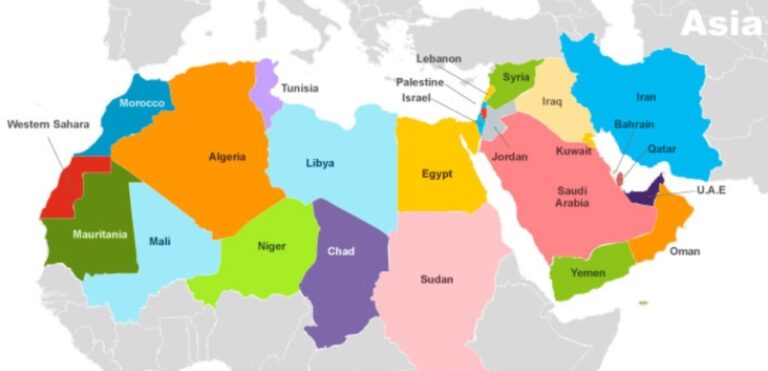
    MENA is an acronym for the Middle East and North Africa (MENA) region. Even if there is no standardized definition, it typically includes 19 countries. These are Algeria, Bahrain, Egypt, Iran, Iraq, Israel, Jordan, Kuwait, Lebanon, Libya, Morocco, Oman, Palestine, Qatar, Saudi Arabia, Syria, Tunisia, United Arab Emirates, (UAE), and Yemen. Depending on the usage, it can be stretched to include further other 16 countries: Turkey, Afghanistan, Armenia, Azerbaijan, Chad, Comoros, Cyprus, Djibouti, Eritrea, Ethiopia, Georgia, Mali, Mauritania, Niger, Somalia, and Sudan.

    MENA market - countries

    Short overview of the MENA market

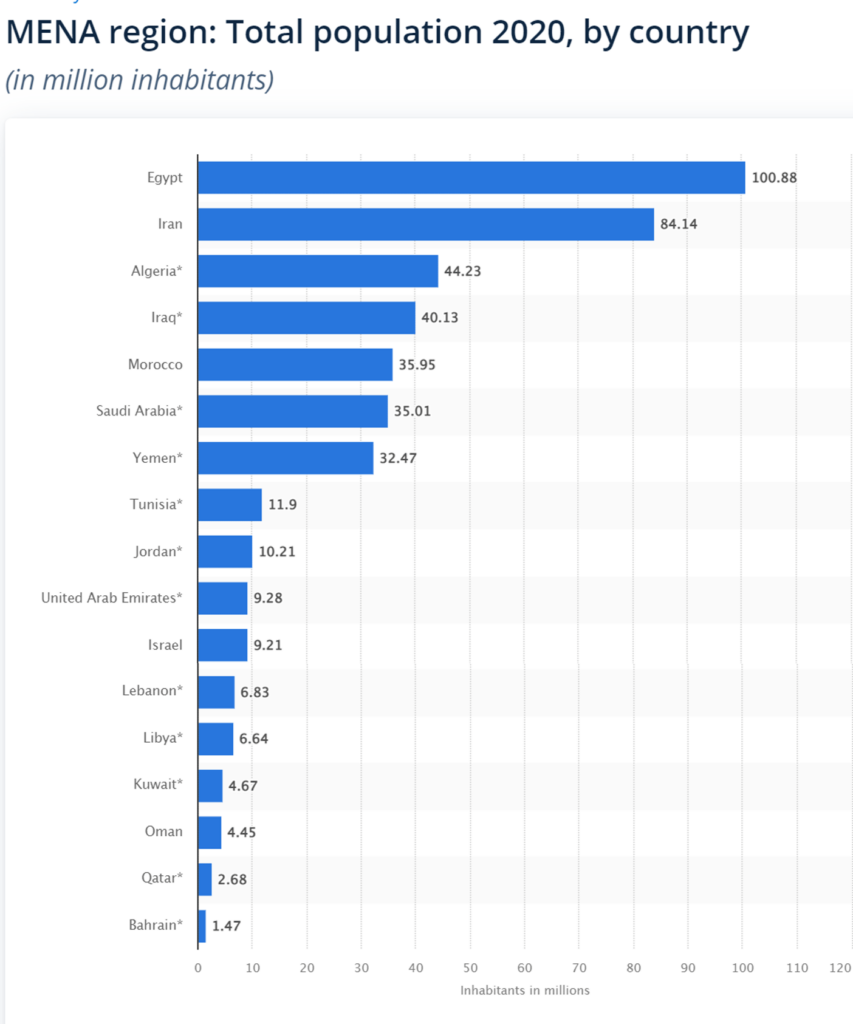
    According to Statista, the total population in the MENA countries encountered approximately 484 million in 2018, it’s expected to grow to 581 million in 2030, and almost double by 2050 to reach about 724 million.


    Forbes named the Middle East “a new leader in emerging markets,” and its continuously growing gaming industry is just one of its many developing areas to keep an eye on.

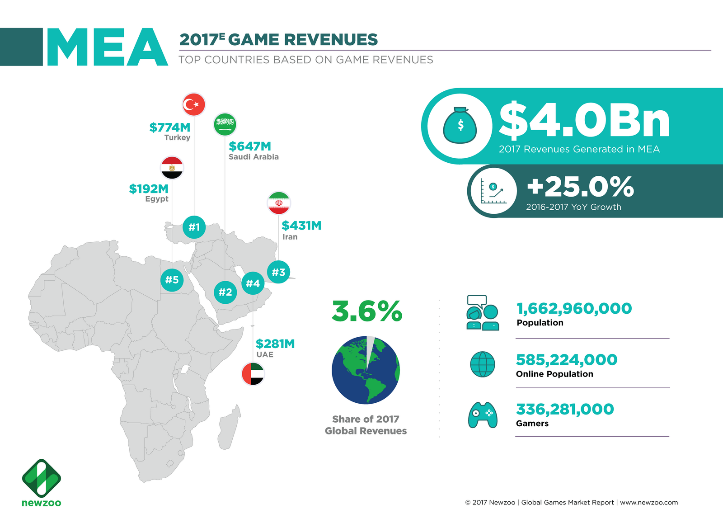
    Back in 2017, the gaming revenue in the MENA region encountered about $4 billion, having at that time the highest growth rate worldwide25% year-over-year growth (compared to Latin America (13.9% growth), the Asia Pacific (9.2%). North America (4% growth) and Western Europe (4.8% growth).

    MENA market - gave revenue
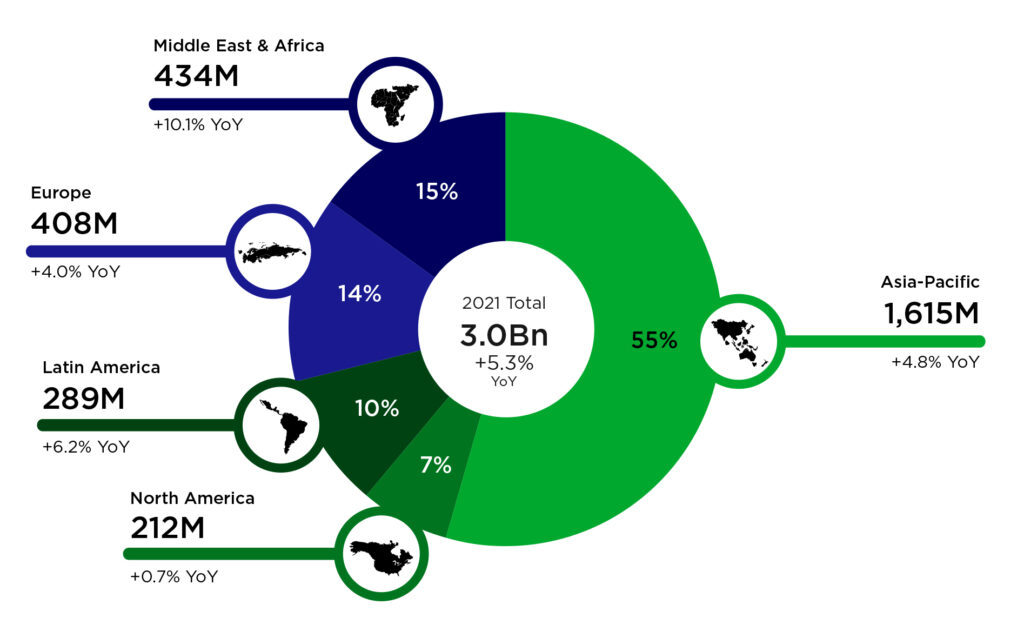
    By 2021, the gaming revenue was forecasted to grow to $6.3 billion. Similarly, the number of gamers had also increased by 10.1% YoY from 2020 and is estimated to reach 434 million in 2021.

    • smartphone penetration is hitting the peak levels in several MENA countries; 46% of the Saudi Arabian residents and 80.6% of the United Arab Emirates (UAE) inhabitants own a smartphone
    • mobile games in the Middle East represent 23% of the total global games market and are expected to become a $2.3 billion industry in 2022
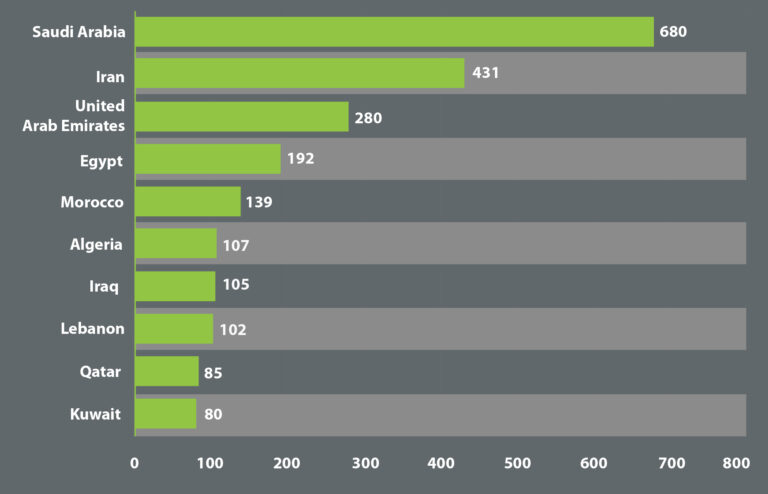
    • according to Statista, these are the leading gaming markets in MENA (January 2021)


    • the region has a high population of gamers, with Egypt leading the way (68%), followed by the United Arab Emirates (65%), and Saudi Arabia (61%)
    • in 2019, in Saudi Arabia, the most profitable Arabic Speaking Market, the Android system was used by 65.6% of the population, being followed by iOS with 34.12%.

    Audience characteristics in the MENA countries at a glance

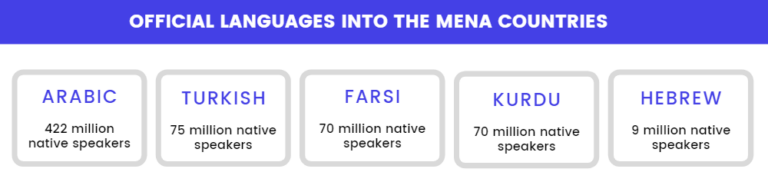
    • the official languages spoken in the MENA countries are:

    MENA market - languages

    • Arabic has 2 forms, Classical Arabic and Modern Standard Arabic, and a variety of dialects.
    • Arabic is the most widely spoken language in MENA and the 5th most spoken language in the world. It is considered “the lingua franca” of the Arab world and the 4th most used language on the internet
    • 44% of men and 31% of women play video games, while 56% of men and 48% of women are mobile players
    • the MENA region is considered to be the “home to the world’s most active gaming community.”
    • the MENA region’s experts claim that the Middle East & North Africa’s potential comes from the fact that “half of the population of nearly 400 million is younger than 25 years of age.”
    • there’s a high level of disposable income, especially within the GCC countries. In 2019, disposable income per person was between $8,712 (Saudi Arabia) and $20,623 (United Arab Emirates)
    • Saudi Arabia and Qatar have the highest average rate per paying user (ARPPU) in the world, with Saudi Arabia having an ARPPU of around $270.55, compared to just $32 in China.

    Still, just a few game developers and publishers localize their games into Arabic. This means that the Mena game market is undersaturated (unlike the European and American markets), and gamers are asking for more content in their own languages.

    Which types of games are favorite on the MENA market?

    Gamers’ preferences are different in every country, but generally speaking, they like to play the arcade, action, sports, racing, and casual games. The market is not as competitive, as the European, and Asian ones. Therefore, if you localize your game, or include some local cultural elements, the chances are to be successful.


    Designed by vector pocket (via Freepik).

    Localizing for the MENA market – What and How?

    Regardless of the target audience, localization is never an easy process. But adapting the in-game elements and the related content for an Arabic-speaking audience might be particularly challenging.

    However, if you want to have a smooth localization process, here are a few core elements to consider that will help you to handle the Arabic localization.

    1. Right to left text orientation

    Arabic, Hebrew, and Urdu are RTL (right-to-left) languages. This has multiple implications for text direction across the game and it means that when developing your game, you shouldn’t lock (or force) the text direction. And this is available not just for in-game content like dialogues, but also for the entire interface, including the menus and other UI elements.

    2. Latin usage

    As mentioned many times, if you aim to provide a real and engaging experience to your users, you must localize the whole content (dialogues, visuals, landscapes, etc). However, unlike in other markets, when targeting the Arabic-speaking audience, you don’t need to translate everything. If they perceive a positive experience, the Arabic players will be ok with transliteration of proper names and having Latin numbers instead of Arabic ones.

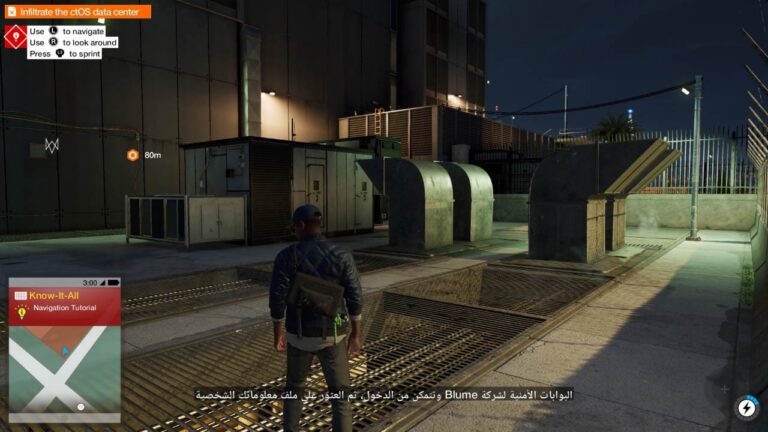
    MENA market - watch dog

    Screenshot of Watch Dogs 2

    For example, Ubisoft chose not to translate the word “assassin” into Arabic for the Assassin’s Creed games. Rather, they transliterated the word instead. This is because the Arabic word for “assassin” has a very dark and negative impact. But in the Assassin’s Creed franchise — at least in an English-speaking context — the “assassin” is actually the hero.

    3. Gender specification and pronouns

    Arabic, like German, Italian, French, and other many languages, has a grammatical gender for almost everything. This can be challenging when translating from English to Arabic, as it can lead to much longer sentences.

    Pronouns in Arabic can also be complicated and can come in many forms. They may include separate/discrete pronouns or pronouns attached to verbs. This means that there’s no clear rule of thumb in terms of the translated sentences’ size, but they could be either longer or shorter than the English ones.

    4. Cultural sensibilities in the countries belonging to the MENA market

    Culturally speaking, the MENA region is mostly a conservative one. This means that when it comes to Arabic localization, many topics that are often represented in video games for western audiences need to be carefully considered. Topics such as explicit sex scenes, nudity, homosexuality, alcohol, religious symbols, mentioning versets from Quaran or quotes from Bible, and polytheism all fall into this category.

    Even if they exist in the original version of the game, you should take care to make amendments so you won’t offend Arab gamers or governments.

    On the other side, you should know that not all the countries that belong to the MENA market are the same. A subject that is considered taboo in Saudi Arabia might be completely acceptable in Morocco, for example (and vice-versa).

    A platform game set tailored around Christmas may be totally unacceptable in Saudi Arabia but Egypt, Jordan, and Lebanon may favor it.

    5. Arabic dialects used in the MENA market


    Petra in Jordan. Photo by Brian Kairuz on Unsplash

    In everyday life, each Arabic country uses its own dialect. Still, all Arabic countries use Modern Standard Arabic (MSA) in writing and official business (contracts, news, books, emails, etc…), even if many consider it a bit formal.

    But as everyone understands it and many developers use it, you should do too, even if the in-game action and events happen in a specific country. Besides, some Arabic dialects are perceived in a specific way and there’s no clear definition or guide that specifies which dialect will suit which game. In fact,According to WSJ, the Egyptian dialect is perceived as the lingua franca for Arabic comedy, Lebanese – for sitcoms, and Syrian is seen as more serious, appropriate for dramas.

    6. Culturalization and inclusion

    Translating the text for the MENA market is itself pretty difficult, but it’s just the tip of the iceberg. Culturalization and inclusion have the same importance for this audience. The fact that the Middle East is a region that is home to amazing sights and many wonders, is not new. Their inclusion matters, especially when these places are represented with accuracy and authenticity.

    In addition, Arab gamers don’t want to see themselves always portrayed as terrorists. And this is perfectly understandable. They also want to see their culture and their celebrities being part of the video games.

    And therefore, fair and accurate representations of the region are important for the players across the Middle East. Some games did a good job catering to local audiences. For example, This Is Football 2004 and FIFA decided to include regional teams in their localized versions. And Mo Salah – a Liverpool player – is the cover star of the 2019 version of FIFA’s franchise, which had a positive impact on Arab gamers from around the world.

    Final word – it’s not just a game!

    The gaming industry in the MENA market is growing fast, and the gaming developers and publishers have some of the highest returns on investment in the world. If you are looking to reach new players and attract new fans, this region should be an integral part of your localization strategy.

    Or do you prefer to expand on a more westernized eastern country first? Then read or Turkish game localization blog post, this country is considered a true gateway to the MENA market.

  • Design Your Game Brand Identity In 6 Simple Steps To Win Your Audience

    class=”entry-content” id=”pix-entry-content”>

    Regardless of the industry, a great brand identity is extremely important in today’s competitive business world. More than ever, if you want to attract and engage with your audience, you need to differentiate from your competition and stand out of the crowd.

    Which are the first words that come up in your mind when thinking about Coca-Cola, Nike, Apple, or Cadbury? Exactly, a strong and consistent brand image. For example, Coca-Cola is associated with fun and enjoyment, Nike with sport and innovation, Cadbury is synonymous with happiness, while Apple emphasizes technological research and advancement.

    In the mobile gaming world, Angry Birds has the highest level of brand awareness among the general population (79%), being followed by FarmVille (48%), Epic Games (45%), Bejeweled (45%), and Farm Frenzy (27%). They make the top five most known games.

    brand identity - games brand awareness

    These games are famous for their entertaining and great animations and their popularity allowed their creators to sell beyond the games, tap into the merchandise market, and even create movie deals. So, when you design and implement a consistent brand identity for your game, you can also succeed in the local and international markets.

    However, having a strong brand will not happen overnight. You can’t expect that right after setting your brand colors, designing your logo, and writing your slogan to gain that special position in your gaming community’s mind.

    You need much more to develop a reputable brand image, and here are the most important steps to consider. But let’s start with the most important part:

    What is brand identity?

    It is the collection of all elements you create to illustrate a specific image in the eyes of your audience. It differs from branding and brand image even if all these terms are many times considered interchangeable. 

    Branding includes all the actions you take to shape your brand and help people to quickly identify and connect with your business. By clarifying what your brand is and isn’t, you position yourself in a specific way in your audience’s mind and give them reasons to choose your products and/or services over the competition’s.

    The difference between brand image and brand identity lies in perspective. Brand image is the customers’ perception of your brand, based on their interactions – from reading your website’s blog post or landing page to speaking with a community manager on Facebook. On the other side, brand identity is controlled by you.      

    In the past, brand identity referred just to the visual elements of your brand – from logo and brands colors to presentations, brochures, and advertisements. But in the digital age, it is the personality that defines your brand in your customer’s eyes. It includes your brand values, visual design, and voice, unique selling point, and how your brand interacts with customers.

    Why do you need a brand identity for your game?

    A few things are mandatory when you interact with your audience but having a strong brand identity is a must-have and comes with many benefits.

    According to a 2021 branding report, 75% of marketers say brand awareness is a top priority for their companies because:

    • 1/3 of customers have a brand in their mind when going to shopping
    • 59% of customers prefer to buy from a familiar brand
    • 54% of the businesses state that brand consistency substantially contributes to their business growth

    Also, Apple, Nike, and Nintendo are the top 3 brands Americans love. What do all three have in common? Right, strong brand identities!

    Some other benefits are:

    1. Gives your business a face

    brand identity - ogilvy

    Do you remember that people are always talking about making the “first impression”? Well, the same happens with brands: when a new customer interacts for the first time with your game, he has seven seconds or less to make an opinion. And here is where your brand identity comes in: it gives your game (and business) a “face”.

    When done right, your players can recognize your game just when seeing only some key parts of your branding. Check below some iconic brands.

    brand identity - iconic brands

    2. Helps building trust and credibility

    A strong and consistent brand identity doesn’t just make your brand recognizable, but it also helps build trust with your customers. Like human-to-human relationships, building brand-to-customer relationships takes time and involves many aspects.

    However, it is also important to deliver what you promised, because your customers will make assumptions on the perceived value of your product starting from what your visual identity and voice look like.

    3. Brand identity increases connection with your customers

    Even if you might not believe it, the values of your business matter to your customers. While your brand’s values may drive your marketing strategy, plan, and actions, it’s also extremely important for your customers when shopping. According to a recent study of over 1,000 millennial-age customers, 83% of consumers prefer to buy from brands that share the same values.

    The values included in your brand identity set you apart from the competition and impose it as a unique brand. They give customers an emotional and tangible reason to engage with your business and drive your sales.

    How to create your brand identity

    Finding a brand identity that is unique and authentic is not simple or easy. In this section we’ll give you the exact step by step process for creating a strong brand identity that passes the exam of time:

    1. Do your research

    Before making any decision related to your brand identity, do your homework. Research and understand the market you act on, identify your main competitors and identify your target audience.

    There are many ways for making your research, some examples of best practices being:

    • Google your game category and analyze the direct and indirect competitors that come up
    • Interact with people who are part of your target market and ask them what game brand they play/downloaded/bought in your niche
    • Check the relevant social media accounts and pages your audience follows and interact with

    When making your research, also make notes about:

    • your potential main target – the ones who would be the most likely to play/download/buy your game
    • who your top-of-mind competitors are –brands that are established and well known on the market
    • how your potential players speak and what they talk about – the main interests and hobbies they have and the language they use to express them

    It’s important to know as much information as you can before moving forward, as it will inform what your brand should focus on and how it can position itself apart from competitors.

    2. Build your initial brand identity

    The best brand identities follow the “DECMS” principles, as they are:

    • Distinct
    • Easy to apply
    • Cohesive
    • Memorable, and
    • Scalable as your brand grows.

    Even if each brand identity is unique, following the DECMS criteria requires creating two key elements: your mission and your brand personality.

    And when deciding about those two, remember that you can’t establish your brand to be everything for everyone. Or at least, not from the beginning.

    So, what’s your mission?

    Your mission is one or two lines that stake your claim in the market. This isn’t necessarily something you put on your website or social media, but it acts as your internal guidelines and helps you answer the right questions about your brand, and aids in creating your brand’s tagline.

    Your unique value proposition is the one thing you’re competing on. Find it, go in on it, and make it a part of your brand’s messaging.

    3. Find the words you would associate with your brand

    When designing your brand identity, try to imagine your brand as a person. What would he or she look like? What kind of personality would your customers be attracted to? This step will help to set your voice tone for all your creative, both visual and written. A fun and useful exercise for how to create a new brand is pitching three to five adjectives that describe the type of brand that might resonate with your audience. I compiled this list of traits to help you get started.

    4. Choose the look of your brand

    Once you’ve set your game’s name and its personality, it is time to think about your brand design—how you’ll visually represent your brand – meaning your colors, logo, and typography.

    Choosing your colors

    Colors are important not just for the way your brand looks like, but they also convey the feeling you want to communicate and help you make it consistent across everything you do. You’ll want to choose the right colors for your brand, aiming to differentiate you from direct competitors and avoid confusion.

    Color psychology is not an exact science, but it acts as a guideline and helps you to make the right decisions, especially when it comes to the color you pick for your brand logo.

    This infographic offers an overview of the emotions and associations that different colors generally evoke:

    brand identity - color psychology

    In addition, try to make all the possible combinations: white and black text over the colored logo, and colored text over the black and white backgrounds. A tool like Coolors might help you to identify the best color scheme for your brand.

    Choosing your fonts

    Fonts are part of your brand image and together with your brand colors convey your brand message. And the best way of using fonts is to keep it simple. Excepting the font used for logo (if you prefer this option), limit your choosing a maximum of two fonts to avoid confusing your audience: one for headings and one for body text.

    An efficient tool can be Font Pair which gives you access to a wide selection of fonts that go well together.

    5. Design your logo

    When thinking about building your brand, probably designing your logo is the first thing that comes into your mind. And this is for good reason: it’s the face of your company and can be all over where your brand exists.

    Ideally, you’ll want a logo that is identifiable, unique, and scalable, so you could use it at all sizes (something often overlooked). A rule of thumb is to consider all the potential places where you might post your logo: starting with business cards, website, social media, and even the little “favicons” you see in your current browser tab.

    If you have a text logo as your Instagram avatar, for example, it’ll be almost impossible to read. To make your life easier, create a square version of your brand logo with an icon element that remains recognizable even in smaller sizes.

    6. Apply your new brand identity across your business

    Applying your branding across your business gives it a cohesive brand story. It reflects who your business is and what it stands for. It sets the stage for every interaction your brand will have with your players, in-store and online.

    Wrapping UP

    A brand image is a big thing to work on, and it can make or break your brand. Without the right game marketing strategies (along with efficient development and localization strategy), it will be challenging to become a well-known brand in the competitive gaming industry. Your download stats will remain low, and you will struggle to generate revenue from product sales. The members of SandVox team are experts in helping you set yourself up for success and stay on track into the future.

    Need more info? Let’s chat today about how we can make the most of your gaming opportunities.

  • The SEO Plan: How Long Does It Take To See SEO Results?

    class=”entry-content” id=”pix-entry-content”>

    You developed a great game, registered a domain name, launched your website, and now, you are eager to see the results. You think about getting free traffic from search engines and about how your visitors will interact with your site and content. But the bad news is, that your website doesn’t exist for them. YET. That’s why you need to develop and implement an SEO plan.       

    This is true for every business aiming to have an online presence and reach the right audience, regardless of the industry. And it is even more important for the gaming industry. On the one hand, because gamers are basically internet users by definition. Second, because the growth rate of the gaming industry from 2006 (USD 8 billion) to 2020 (USD 160 billion) is higher than that of all other entertainment industries. In one of our previous posts, we shared with you seven SEO strategies for gaming websites that will help you rank in Search Engines Results Pages (SERPs).

    Let’s quickly recap these strategies:

    • optimize your website for both short- and long tail keywords
    • create blog posts and video content
    • use updated content as part of your SEO strategies
    • think mobile
    • optimize for voice search
    • use gaming forums to create quality backlinks
    • use social media

    However, when speaking about implementing any SEO plan, the main question is: How long does it take to see the results? And this is also the most frustrating question because unfortunately, the answer is more complicated than the question. It depends.

    Indeed, truth to be told, SEO is a really long-term game. It’s not like paid media where you see the results (almost) when you start an advertising campaign. The winners of the SEO game are those who work patiently, continuously, and methodically to improve their websites.  

    While you, as a gaming developer understandably want a definitive solution and timeline, there is simply no way to provide one due to all the variables involved. So, let’s break it down.

    How does SEO success look like?

    Before answering this question, you first need to understand what SEO success is to ensure that your performance metrics are clear. 

    And when thinking about developing and implementing an SEO strategy, you should consider both campaign goals and KPIs.

    • Goals are the end outcome you want to achieve. For example, your goal is to achieve a certain increase in your revenue/sales/downloads for your games over 12 months.
    • KPIs (Key Performance Indicators) are metrics that demonstrate the progress you made towards your goals. For example, some of the most common SEO KPIs are organic traffic, impressions, visibility, and rankings.

    We have to mention that setting goals means setting measurable yet realistic targets. You can’t expect to rank on the #1 page of Google in a few weeks after launching your website or publish a blog post.

    In fact,

    You should expect to see SEO results within 6 to 12 months

    Realistically speaking. You should see SEO results within 6 to 2 months. By results, we mean a significant increase in traffic and the associated conversion or the number of leads. You don’t necessarily mean you completely achieve your goal(s) by this moment. But if you consistently invest in your SEO efforts, you should see some results in this timeframe.

    You should also know that SEO takes time because Google (and also the other search engines) intent to show the best results that fit the users Search Intent (according to their inquiries). And this takes time, especially when your website is new. But if you develop and implement the right SEO plan, you should be able to see results that justify your SEO efforts and investment.

    Factors that affect your SEO

    As mentioned before, there are a lot of elements that affect your website.

    Your website’s history

    Whether you have a startup and you’re working on a new website or want to improve an old one, your website’s history is one of the core factors influencing the needed time to see SEO results. A new domain (and website) will automatically take longer to rank in SERPs than an established one because it doesn’t have yet any authority and earned backlinks. On the other side, an established domain usually has at least some level of authority and at least a few backlinks pointing to it.

    A brand-new website should expect to see results within 9 to 12 months from the beginning of implementing the SEO plan, rather than 6 to 12. 

    Competition

    When optimizing your website for local or for lower-competition keywords, the chances are to get promising results much faster than when choosing the highly competitive ones. Usually, 3 to 6 months.

    When setting your keywords, you must use one of the multiple SEO Keyword tools on the market. This way, you’ll get access to info such as Search Volume (SV), Keyword Difficulty (KD), Paid Difficulty (PD), Cost per Click (CPC), and more.

    Search Volume gives you the average number of monthly searches for a given keyword over 12 months, while Keyword Difficulty shows you how hard it would be to organically rank in the top 10 for that keyword. The higher the percentage, the longer it will take to see the results.

    Besides, you should check how your competitors got their position in SERPs and what they are doing to keep it.

    Content

    Your website’s content is also very important for your SEO plan, and the very first thing you should know is that quality matters. A lot.

    Sure, according to the Backlinko study, long-form content performs better than the sort-form one. We should mention that these numbers differ according to many factors, but ultimately, the quality matter the most.

    SEO plan - long-form vs short-form

    The role of backlinks in how long it takes to see the results of your SEO plan

    It’s no secret that links play a huge role in SEO, but their impact on how long it takes to see significant results depends on several deeper factors.

    The first is the volume of links your website receives.

    Usually, the more links you get, the sooner you achieve SEO success. However, it’s not just a game of numbers, but also of relevance. Fewer high-quality links from relevant websites will have a much greater impact than a bigger volume of low-quality backlinks from irrelevant sites.

    You should know that the search engines also consider the speed at which you earn links, as it is an indicator of natural or unnatural growth. And if you are trying to manipuöate ranking, you could face a penalty.

    Let’s compare the three graphics:

    The first looks natural:

    SEO plan - natural link growth

    The second one looks less natural but depends on many other factors. For example, when starting an SEO campaign, publishing amazing content, or a new product launch, it could be very normal:

    SEO plan - maybe natural link growth

    This looks completely unnatural:

    SEO plan - definitely unnatural link growth

    So, generally, the faster you can earn relevant, high-quality links, the faster you will rank.

    How long does it take to see the results of your SEO plan?

    As mentioned before, it depends on many factors. Some of them are previously listed. Besides, you should know that even when two websites are launched at the same time, in the same industry, and compete for the same audience, they will still have different rankings.

    However, here is a realistic scenario of what your SEO efforts might look like during the first few months, and the results you could expect.

    SEO plan, phase 1: Research, analysis, and strategy

    Your SEO strategy must be based on realistic data, so you have to pay special attention to the research stage. This includes a general analysis of your competitors and the keywords they rank for, the short- and long-tail keywords used by your target audience in their queries, and possibly their synonyms. The gathered data should result in setting the core keywords you want to rank for.

    If your website is not new, then you should also perform a technical audit.     

    With all this data you should be able to develop an SEO strategy and a monthly SEO plan.

    SEO plan, phase 2: beginning of the SEO optimization and content strategy

    The second stage consists in developing an SEO and content strategy and starting working on technical SEO.

    The last one means making the site modifications, based on the technical audit. In addition, you should start working on the link profile and developing a content strategy, as well as a social media strategy, paid ads, or other methods to promote your content.

    SEO plan, phase 3: implementing the SEO and content strategy, analyzing the results, and making the adjustments

    Starting with this stage (3rd or fourth month), you should focus on content creation. Blogging, FAQs, whitepapers, articles, expanded product and company information, etc.  – are just a part of your content.

    However, you need to optimize them according to the keywords you set and to the off-page and on-page SEO best practices. You also need to continue working on the technical optimization of the website and developing a healthy link profile (which may include cleaning up low-quality links)

    Starting by the fourth month or fifth month you could expect to see a significant increase in traffic, ranking, and lead generation. Obviously, you’ll not get yet the planned results, but they should be significant enough to know that you are on the right track.

    It’s also the right time to start implementing the social media strategy you developed. It will help you promote your content and increase direct traffic to your website if you focus your efforts on the right platforms. This results in a natural and healthy link profile and will generate leads by itself.

    However, when having enough visitors monthly, you could add conversion rate optimization to your efforts. This way you’ll convert more visitors you get on your website into leads and/or sales.

    Don’t forget to analyze the results of implementing your strategies and SEO plan and adjust your actions when needed.

    Final words

    Many SEO companies will tell you that it takes four to six months to see the results of your SEO efforts. However, keep in mind that this is the beginning. Whatever results you see in the first six months, they’ll be much less than in 12 months.

    Therefore, it’s important not to stop too soon (when you see the first positive changes). Keep in your mind that SEO is a long-term game that requires time and money. You can’t budget it just for 6 to 12 months, it’s better to invest that money in something else. But when done correctly, implementing the SEO plan is a digital marketing tactic with one of the best ROI out there.

  • Italian Market Localization – Does It Really Matter In 2021?

    class=”entry-content” id=”pix-entry-content”>

    Ok, you finished your game 😊. Congratulation! Now, what? For sure, you want to sell it locally, but your wildest dream is to have a product that conquers the international market – from Europe to Asia to the USA, LatAm, Australia, and the Arabic countries. What does it mean? Well, you need to know that adapting your playing for multiple markets is just a part of the game. And if in our previous articles we talked about how important is to translate and localize your product into FIGS languages, with this post we’ll focus on the Italian market. 

    Why is it important for the gaming industry? And what are the special traits that make you consider localizing your game for the Italian audience?

    Let’s see.

    Selling your game in Europe means you target a mature market. With a revenue of $29.6 Billion in 2020 and 7.8% year-over-year growth, Europe is the world’s third-largest gaming market after Asia-Pacific and North America.

    Italian market localization - regions distribution

    No matter what you say, localization for the European market is not easy, as the audience is characterized by a variety of languages existing in their respective countries on the continent. And this brings both complexity and unicity.     

    Usually, games consumed on the old continent would always receive translation and localization and in the previous articles, we explained why it’s important to localize for the Polish, Finish, Swedish, Dutch and Danish markets. This post is part of our series of articles dedicated to the French – Italian – German – Spanish markets and aims to help you figure out how to address the Italian market.

    With a gaming industry revenue of $3,482 million in 2020, Italy was the ninth market in the gaming industry and it’s also a complex one. Therefore, it’s important to understand the Italian audience to be able to attract and connect with your potential and actual players.

    Italian market overview

    Approximately 63 million people in the world speak Italian as their first language and an additional 3 million speak Italian as their second language.  Even if the various sources have slightly different numbers, Italian is considered to be the 20th most-spoken language in the world.

    Italian is the official language in Italy, Vatican City, Switzerland, and San Marino. and also in some parts of Croatia and Slovenia. There is a relatively sizeable number of Italian speakers in Albania, Belgium, Malta, France, Bosnia and Herzegovina, Liechtenstein, Croatia, Germany, Romania, Slovenia, United Kingdom, Luxembourg, Australia, Canada, the United States, Argentina, Brazil, Costa Rica, Egypt, Eritrea, Israel, Libya, Paraguay, Philippines, Puerto Rico, Saudi Arabia, Tunisia, United Arab Emirates, and Venezuela.

    Image by Pharexia

    At the same time, according to EF, Italians don’t have a very high proficiency in English, ranking in the 30 out of 100 countries.

    Italian market _ EN proficiency

    So if you want to attract and engage your Italian players, you need to translate and localize your game, especially when it’s a complicated, interactive one where they have to make quick decisions.

    Italian gaming market

    Additional gaming industry statistics are:

    • Italy is the third-largest economy in the European Union and the 9th market in the world
    • With total revenue of over €1 billion and a constantly increasing trend, Italy is the 4th gaming market in Europe
    • According to GameIndustry.biz and Newzoo, the Italian gaming market reached 35 million gamers and $3 billion in revenue in 2020.
    • In Italy, 30% of the population plays games, with the main audience aged 25-34.
    • Over 50% of the over-14 gamers play video games (a total of +25 million people)and the video games expenditure is expected to have an increasing trend in the next few years 
    • The average revenue per user (ARPU) is around 28 euros, while the Italian gamers tend to pay more for PC games than for mobile games.
    • In terms of game genres, the top three are action games, shooters, and sports, with FIFA being the favorite from the sports game category.
    • 57% of the video games on the Italian market are considered suitable for players younger than 12. This means that more than half of video games target a potential audience for which translation and localization in Italian are absolutely necessary to be able to play.

    Italian localization essentials

    Which……. Italian?

    Yes, you read right. Which Italian?

    Italy become a single nation in 1861, at which time less than 10% of its citizens spoke the national language, Italian. In the first half of the 20th century, Italy was a ‘diglossic country’, where people spoke at home their local dialects, while Italian was learned at school and used for official purposes.

    And believe it or not, in Italy there are spoken 34 dialects. Italian became the official language of the country in 2007, while Tuscan, Neapolitan, Sicilian, Venetian, Ligurian, Sardinian, and Apulian are the most famous dialects.

    Italian market localization - Italian dialects

    So, before even thinking to start developing your translation and localization strategy, decide which region you want to target with your game. As 96% of the population speak standard Italian (which is actually the original regional dialect of Tuscany), it means that when localizing for the Italian market, it is pretty safe to always choose Standard Italian. But if you really want to make one step further,  and make players from a specific region immerse within your game, you should consider localizing into that dialect.

    For example, here are 3 different possible translations for “we are arriving“:

    Standard Italian: stiamo arrivando
    Venetian: sémo drio rivàr
    Venetian dialect: stémo rivando

    Length of expresions on the Italian market

    Generally speaking, the Italian text is between 10% and 30% longer than English. Even if this should not affect your general layout and the UI of your game too much, you should not forget about it during the translation ad localization process.

    But when your game is dubbed, make sure translators have information about shot changes or time codes.

    Special Characters

    Italian may use the Latin Alphabet like English, but the letters j, k, w, x, and y don’t exist unless used for Latin expressions or foreign words.

    On the other side, Italian is not the only language that uses special characters like è, à, ò, ì. The tricky part here is not the English – Italian translation but using the right font that can recognize these characters and display them correctly.

    Gendered nouns

    Like many other languages, Italian uses gendered nouns. For example,

    • table can be either “il tavolo” or “la tavola”
    • Il cameriere (waiter) / la cameriera (waitress)
    • Il parrucchiere (hairdresser man) / la parrucchiera (hairdresser woman)
    • il gatto (male cat) / la gatta (female cat) 

    Therefore, if you want to avoid any unfortunate mistake that can destroy your game, you should give the translators information about the gender of the game’s characters.

    Conclusion

    Being one of the main languages of Europe, Italian remains a rather straightforward language when localizing, if done correctly.

    Localizing your game and the additional content for the Italian market may seem a challenge. However, you can successfully make this step and achieve all your business goals with the help of experienced people. Feel free to reach us, and we will gladly make these steps together with you!

  • Game Marketing 101: How to Identify the Buyer Persona for Your Game

    class=”entry-content” id=”pix-entry-content”>

    If you were to ask a game industry professional what the first thing you should think about when developing a game (or even earlier, when you first have an idea about a potential game), they would answer: target audience (or buyer persona.

    Why?

    First, because knowing who you are targeting will increase your chance to develop a high-ROI (Return on Investment) product. Let’s imagine this: when creating a game, think about the person who will play your game. Imagine the following dialogue:

    “Player: Oh, I love so much this game! I spend hours playing it! It’s so interactive and gives me so many options! I just love it! I would be glad to pay to download/play/buy it!

    You: Oh, I love so much selling this game to you! I’m so happy you enjoy it!”

    This hypothetic discussion can become real only if you really know your target audience and create games that completely meet their needs and desires.

    Second, because knowing how the people who will play, download or buy your game look like helps you to have a coherent business strategy. Especially when you are a gaming startup.  

    Third, because knowing your target audience helps you to set your game’s brand voice and visual identity while developing and implementing an effective marketing campaign.

    But what is a buyer persona?

    Before discussing why you should use buyer personas for your game and how to identify them, let’s see what they are.

    A buyer persona (or player persona, in our case) is an abstract representation of your ideal customer (player), based on qualitative and quantitative insights provided by the competitor/market research and existing customer profiles. It includes both demographic and behavioral information about your target audience, describing it in detail and putting the spots on their needs, preferences, and challenges. This way, you split your target audience into specific groups that share similar interests and characteristics.

    Your buyer persona(s) should be able to answer the following questions:

    • Who is your buyer (sex, age interval, occupation, income, marital status, place of living, etc)
    • What game genres does he/she usually play? (action/adventure/strategy/casual games or something else?
    • How does she/he use to play (session duration, device, location of playing, etc.?)
    • Does he/she buy games and what influences the purchase decision?
    • What kind of frustrations/complaints/worries does he/she have that might discourage him/her from playing the game before or after purchase?
    buyer persona - define target audience

    Why should you care about buyer personas?

    Because determining buyer personas is the next logical and one of the most important steps in defining your marketing, product, and overall business strategy. And we can’t stress enough with this.

    Identifying buyer personas helps you to find qualified leads and retain your existing clients. By micro segmenting your target audience, you can create personalized marketing and content campaigns that result in attracting high-value customers, improving your conversions and customer retention, and increasing clients’ loyalty.

    In addition to helping you to understand how your buyers look like, and why they would be willing to play your game, target audience personas are important because:

    #1 They help you target the right people at the right time with the right message

    If you want to develop and implement successful game marketing strategies, then buyer personas are a core part of them. They give you an idea of what messages your audience will respond to and help you address the needs and concerns of each segment by creating tailored marketing messages.

    #2 Buyer personas assist you in establishing your brand authority

    Brand authority refers to the trust your brand/business has earned among customers over some time and the degree to which they see your brand as a thought leader in your industry. Many factors can influence your authority, some of the most important being an active online presence, compelling content, and engagement over social media.

    The more trust your brand gains, the more customers will be willing to play your game and recommend you to others. You’ll see an increase in customer loyalty and retention, which is important in a such competitive market. 

    #3 They help tailor your products (games and additional products), messages, services, and business as a whole to meet your customers’ needs

    The more you know about your target audience, the better you can meet their needs. Understanding their preferences and concerns allows you to create customized content that is helpful and valuable for them. 

    As a rule, your content strategy must include different content for each of your buyer personas. An excellent, creative and efficient content marketing strategy should maintain your brand’s style and tone of voice but vary according to who you’re targeting.

    buyer persona - elements

    How do you successfully set up your buyer persona(s)?

    Follow these steps:

    • Collect personal information: if you want to have a realistic picture of your player personas, you should rely on real information. Collect details like age, geographic location, spending habits, and stage of life, the best methods being online surveys, forms, giveaways, and more. As most people like to remain anonymous, online surveys could be the best method. 
    • Include professional details: knowing the professional details of your target audience is important as they give you an understanding of their potential income and spending power.
    • Find out their goals and challenges: when you know your consumers’ goals, you can understand their interests and have a clue about how your game might fit into their lifestyle. You can collect this information by social listening (a technique used to monitor social media for mentions of your brand) and by taking inputs from your sales team. The last one interacts directly with your real customers, so they know what people want to accomplish by purchasing or subscribing to your game. 
    • Where they are: If you want to know how to reach your audience, you need to figure out where to find them. Check out the gaming platforms they use, the games they play, the social networks they spend the most time on, and the type of content they consume. For example, if your buyer personas spend most of their time on Twitch, then this is a great place to reach them. This way you’ll send the right message to the right market at the right time. 
    • Negative information: Even if you think you don’t care about the negative buyer personas, they are also important because they represent the potential customers to whom you don’t want to sell. By knowing them, you save time and money, while directing your efforts to the right target audience. For example, they could be potential customers who are too expensive to acquire or anyone who doesn’t fall in your category of business interest.
    • Values and fears: Understanding the positive and negative motivations of potential customers is the essence of great marketing. This information gives you a psychological view of your target audience and shapes your marketing strategy. In this way, you can create a narrative that your target personas connect with, improve lead generation and increase brand trust. 

    After gathering and combining all this information, it’s time to create your buyer(s) persona. To “humanize” it and make it real, give a name and set an avatar.

    An example can be:

    • Buyer persona name: Bob J.
    • Age: 26- 30 years
    • Avangardist: Likely to buy the latest gaming consoles when released in the market, or purchase the latest game releases online
    • Interests:  trends and changes in the gaming industry, familiar with esports and adventure games. 
    • Bottom line: Wants to watch, play, and own everything. 
    buyer persona example

    Tools for creating buyer persona(s)

    Xtensio – This is a free tool that allows you to create your own buyer persona (among other tools for creating shareable documents and presentations). It’s an attractive and easy-to-use template that you can use for any business to get a handle on your clients fast. Create multiple personas, collaborate, edit, download, and share.

    Userforge – unlike other user persona generators, Userforge gives you more freedom to create your own criteria. If you know what’s important to your marketing efforts in terms of segmenting your audience, then this might be the best tool for you. Create quotes, blocks of text, and lists to help you and your colleagues narrow down your ideal clients and focus your marketing efforts.

    Smaply – gives you the tools to create buyer personas, journey maps, and stakeholder maps, so you have a visualization of your customer experience. It provides you with a smooth experience, as you can cooperate with your colleagues in creating the personas you need. Also, by combining the persona creator and journey maps you can describe the steps a customer takes before buying a product or using a service.

    Final words

    Finding your customers’ prototypes has multiple advantages. The more you can focus your PR and marketing efforts on the right target audience persona the more time and money you’re going to save in the long run. Creating a plan to understand your buyer persona is not an easy task, but these basic tips should set you in the right direction to properly market your games to the people who want to buy them.

  • French Market Localization – A Foolproof Way to Increase Your Fan Base

    class=”entry-content” id=”pix-entry-content”>

    Far Cry, Assassin’s Creed, Alone in the Dark, Beyond Good and Evil, Another World (also known as Out of This World), Prince of Persia. There are just a few names that every developer and gamer should know. What do all these titles have in common? That’s right, they are the names of some of the best video games, and all of them were launched on the French market. 

    The same market that is defined by the language of love and diplomacy, France ranks 7th in the top 10 nations producing the max game revenue in 2020. Besides, French is the official language for 270 million people living in 29 counties, two-thirds of the French native speakers living in African Francophone countries. Not to mention the existing markets in Belgium, Switzerland, and Canada.   

    French market localization - French-speaking countries

    In addition, French translation and localization also add the potential emerging markets like Rwanda, Cote D’Ivoire, and DR Congo on the lists.

    What does this mean? Let’s see some information:

    Stats about the French gaming industry

    Consider these data:

    • the gaming industry in France is continuously booming, the country having a video game revenue of 5.32 billion Euros in 2020
    • the French video game market includes over 30 million mobile gamers, more than 37 million pc gamers, and at least 13 million console gamers
    • trivia and sports are the most popular game genres in France
    • 68% of the population in France play video games regularly
    • men and women play almost equally: 43% are female gamers and 57% are male,
    • the predominantly male audience is slightly younger (10-35 years-old males vs 21-35 years-old females as the most active audience)
    • spoken by an estimated 2,18% of users, French is the 7th most common language on the Steam gaming platform

    2025, up from $2.66 billion in 2021.

    Console gaming is the preferred gaming platform in France, followed by mobile games. In 2020, console gaming sales in France amounted to €2.7 billion, representing 51 % of the market.

    Things to consider before expanding on the French market

    Before deciding to localize for the French market, you should think about:

    The Customer

    In terms of e-commerce, the French market is relatively mature, but still full of opportunities for online sellers. France is characterized by several unique consumer traits:

    • in 2016, two-thirds of the French population shopped online in the last 12 months
    • according to one study, the regular French e-commerce buyer is between 35-49 years old
    • and although you would have expected those born and raised in the internet age to be the main customer base, the millennials aged 25-34 are in 2nd place

    According to Statista, e-commerce user penetration for 2021 was projected at 74.1% with 78.0% expected by 2025. However, due to the unpredictable pandemic, the multiple lockdowns, and social distances restrictions in the last two years, these figures are most likely already underestimated, while eCommerce has boosted exponentially. When thinking about the French players, you should also consider that almost half of the gaming audience played video games nearly every day or more often, and the average weekly gaming time amounts to approximately 9.2 hours.

    Besides, French-speaking consumers expect to shop in their native language. So, translating your game is a genuine way to be polite and show that you care. 

    Politeness, respect, clarity, and promptness are traits that French consumers look for when opting for e-commerce, so keep all of this in mind. Therefore, as a game developer, you would be remiss not to translate and localize your content for the French market.

     An average of 57.25% of the French population has “reasonable proficiency” in English. This is one of the reasons why French-speaking consumers expect to shop in their native language, and your effort will be appreciated as essentially polite. Therefore, translating and localizing your content into French will give you access to a market in which almost 40% of will shop cross-border.

    French market characteristics

    As mentioned before, the French market is a mature one. French e-commerce was valued at $114.4 billion in 2020 and it’s expected to reach $203.57 billion by 2026. At the same time, we can say that the online market has some unique characteristics.

    On one side, there are the big e-commerce players: Amazon, Vente-Privee, Cdiscount, and Auchan are frequently used by 25% of all French online shoppers. On the other side, it is also a niche dominated by the small boutiques for which the physical locations are still very important.

    This means that medium-sized online sellers are not as prevalent as in the German and UK markets, which offers great growth potential for cross-border e-commerce. Multiple delivery choices and improved logistics have also played a huge role in the development of e-commerce in France. And this is because the French audience pays great attention and has very big expectations about their products’ delivery.

    Speed, reliability, and convenience are very important here. A 2016 Royal Mail report showed that in France, delivery matters the most. According to the same study, 92% of French shoppers want upfront delivery information while 72% consider delivery costs as the largest barrier to purchasing.

    Payment methods are another aspect to mention. Even if half of the French online shoppers prefer to pay with debit and with credit cards, PayPal is still a used by a quarter. 50% of shoppers use payment cards (Cartes Bancaires) for e-commerce purchases so you must also check them as an option.

    Tips for translating and localizing your content for the French market

    Decide about which kind of French you are looking for

    As mentioned before, French is spoken by 270 million people living in different countries across the globe. And just in France, there are 28 regional accents. Therefore, identifying which French you are targeting should be your first step to a successful localization.

    Length of the expressions

    Typically, French is 30% longer than English. And due to the limited UI space on mobile devices, developers often must make adjustments. Therefore, it’s important to work with professionals who find the right balance between localization quality and user-friendliness. 

    Consider formatting

    English and French are different in terms of formatting, and you don’t want to skip this part when localizing your game. For example, in English quotations are usually marked with (“ ”), while in French, you could use guillemets (« »).

    Also, you should always use non-breaking spaces before punctuation marks (exclamation marks, colons) as well as space separators for numbers where English uses commas (e.g. 10,000 becomes 10 000). All these details could be easy to overlook, but they are still part of good localization.

    Prioritize context

    When it comes to translation and localization, context is the king. Start by taking into consideration that you share your game, other product, or service to a completely new market. A market that has other values, customs, and rules.

    That’s why is important to provide translators with all the context you can, so they can completely understand your product and give a great output.  

    Formality

    Like other languages – for example, German and Spanish, French has the formal pronoun for “you” (“vous” in official settings and “tu” in more informal situations). The titles can be used to demonstrate respect to the interlocutor.

    Test your game/app/website before launching

    Technically, Game Localization Testing – or Localization Quality Assurance (LQA) – is the last step when of the translation and localization process. It is essential when focusing on language testing, translation quality assessment, and UI/UX features.

    In this stage, you should also consider the functional and compliance testing and make sure that all parts fit perfectly together.

    Final words

    When you target the French-speaking audience with your content properly localized, you can gain access to millions of online fans and buyers, resulting in increased sales and profits.

    Localizing your game and the additional content for the French market may seem a challenge. However, you can successfully make this step and achieve all your business goals with the help of experienced people. Feel free to reach us, and we will gladly make these steps together with you!